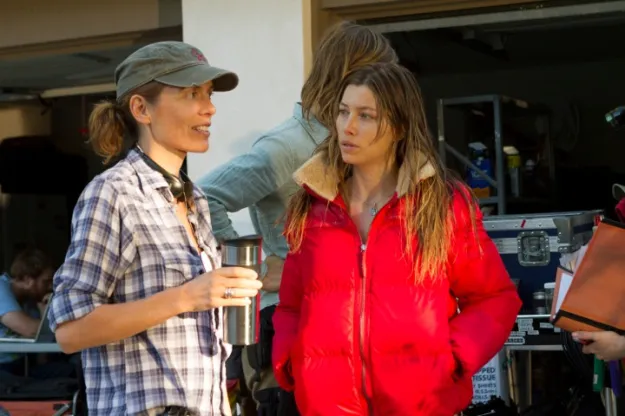
Inaugural Coffee with Creatives interviewee Diane Bell speaks with Jessica Biel, while on set for her film Bleeding Heart.
NOTE
: Below is the original text version of my interview with Diane. After our talk, I decided to turn Coffee with Creatives into a podcast. You can now listen to our talk
here
.
—
Welcome to the first post of a new, recurring feature here on mdibiasio.com!
To skip straight to my interview with filmmaker Diane Bell, click
here
.
The idea for Coffee with Creatives came to me while thinking about how to solve two problems. As I mentioned in the introduction to
my previous post
(the first of another “new” recurring feature), the two main goals I have come to adopt with my work here, and in general, is to push for a greater sense of interpersonal empathy and, related to that, to be a better member of the various communities of which I am part.
In addition to providing testimony about the origins and processes behind my own work, I want to more often use this space to discuss the work of others, not only in terms recommending the work itself but as a way to identify practices, resources, and workflows that might be useful to readers. Over the course of the last few years especially, I’ve met (and have formed friendships with) a lot of interesting, similarly-minded people. It’s
a far cry
from the pre-
Multiverse
days, and I’d like to keep it up.
Lately, though, with all the pressures I’ve put on myself, to finish
The Videoblogs
, and to keep moving in general, despite the ongoing challenges of the artistic lifestyle — it’s become difficult to get out and actually meet people (especially online friends from Twitter), even after forming general plans to do so. This, in turn, has also made it harder to commit to doing my part to build community, and to share information here, in the sort of ongoing and more useful ways that to me would be a good complement to the semi-regular essays I otherwise post in this space.
So, Coffee with Creatives is my attempt to find a way to set aside some time to hang out with some cool people, in real life (as often as possible, some virtual coffee-drinking will go on), as well as to take the opportunity during that meeting to ask questions about their lives as creatives, such that you and I can learn some things, and, perhaps, feel less alone as we struggle to create.
And, as I have said so many times before, I believe
all of us
are fundamentally creative.
From now on, twice per month, I will have coffee with a creative person (filmmakers, writers, musicians, visual artists, organizational professionals friendly to the arts) and interview them based on the same general list of questions as those asked below. Probably, as was the case during this first conversation, other questions will also come up, as my guest and I begin digging into details. For the beginning, especially, I will probably keep things fluid in an effort to find out what format works.
Today’s inaugural post is with Writer/Director Diane Bell,
who I met on Twitter during a Seed&Spark
#FilmCurious
chat. We quickly became online friends, and then met briefly in person when I caught her sophomore feature,
Bleeding Heart
, at this year’s Tribeca Film Festival.
Diane’s first feature film (and first film, ever!),
Obselidia
, premiered at Sundance in 2010, where it won two awards. She’s also
currently crowdfunding
her third film (on Seed&Spark),
and her campaign ends TODAY (May 8th)
. Check it out when you’re done reading, and pitch in or share the campaign if you feel so inclined.
One last quick note…
After recording my talk with Diane, it occurred to me that Coffee with Creatives may be better suited to the podcast format. Some nice back-and-forth went on at points, that I’ve mostly omitted here, because I was pressed a bit for time in getting this out, and also, for now, I think it’s more important to hear what she has to say only, without me interrupting with information about my work that you may already know or can otherwise find here later. I’ll need some additional time to source the podcast idea out, and to see if and how I could make it happen.
But I hope you enjoy the interview. It was a fun talk. Check out what Diane has to say below, and please feel free to ask a question or add your point of view in the comments.
What’s your primary mode of creative output?
I still think of myself primarily as a writer. Specifically, a screenwriter. I also direct films.
What are you currently working on?
The film I’m working on right now is called
Of Dust and Bones
and I wrote it and am intending to direct it this summer. It came to me really as a reaction to how I was feeling last year. I don’t know about you but I was feeling very depressed about the world. I go through phases. I think the world is getting less violent, overall, compared to the last century, to look on the bright side. But suddenly last year I just felt really like, “This is too much”.
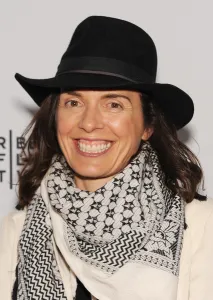
Diane at the 2015 Tribeca Film Festival
The world was so cruel and so sick and it didn’t seem to be getting better. And in the midst of that I was also having a sort of struggle finishing my second film,
Bleeding Heart,
which recently premiered at Tribeca. I was really having a tough time and I was really questioning everything.
And out of that came this movie,
Of Dust and Bones
, which is addressing these questions, like: How do we live in a world that has this terrible problem? (
Note: The main character of Diane’s film is a woman whose war-photographer husband died in Syria
). And that was the question that was driving me that I felt I had to write something about. For me, I’m definitely somebody who, the things that I write, they always come from that in a sense, like some sort of problem I see in the world that I can’t really process in my own life so I try to process it through a story. So, if all goes to plan, we’ll be shooting
Of Dust and Bones
in July.
What do you get the most joy out of, and/or what would others say you’re best at, not including the above? Creative or otherwise.
In life in general, I get the most joy out of being present. That is why I write and why I direct. Those things bring me joy because they allow me to access that zone of presence.
I’ve been a longtime practitioner of Ashtanga yoga, for fifteen years now, and that gives me huge joy, as does my meditation practice. And my child. Being a mother. Looking after my little guy, who has given me the greatest joy ever. Because it’s just presence. Children are just little zen masters who wake you up to what’s important in life and what really isn’t, and there’s no doubt that that’s the best thing that’s ever happened to me.
How do you balance a commitment to presence with the reality of how hard it is to produce a film? Do you work hard to keep that goal of remaining present trickling down throughout the production?
For me, yoga definitely informs my approach to filmmaking, in terms of how the focus is on the process as opposed to the result. And during the throes of it, I’m really calm. Someone will visit me on set and say: “Wow, you’re the least stressed”. I guess I have a real clarity when I’m in that situation. I think it comes from yoga because I totally let go of the result.
Because I think, whenever we start thinking of results — that’s when we get stressed out. To me, the result, you don’t control it. You’re never in control of how it’s going to turn out. You’re not in control of how it’s going to be perceived by other people. A film can be brilliant — frequently, brilliant films come out and nobody watches them. It’s a terrible business. Twenty years later everyone acknowledges it’s a brilliant film. There’s no control over any of it.
And I think for me, the relief from that is just not being stressed, just to be focused on the process and what you’re doing. One thing at a time, in a sense.
In my last film, there were definitely challenges with some of the people I was working with. They had some very different ways of working than I did. I’m talking specifically about producers. And it was really hard. And it did push me. What it pushed me to, ultimately, was to really think hard about my process, and how I worked best, how I want to work. I said to myself, okay, this was a mistake, we have different ways of working, maybe we shouldn’t be working together. And I think when you realize that, you ask: What do I value?
For me, that clarified my own path. So I’m making a much smaller film this time because I know what’s important to me and what I want to do. I realize that some things aren’t important. How do I tell stories that I really care about? How do I get to work with people who are in a similar frame of mind, where we can push ourselves creatively to take risks — rather than minimize them, which is the typical thing in our industry.
I think that kind of distress — this is the joy of something like meditation. It can give you that little bit of distance from distress, so that you can assess it in a different way and learn. Certain stresses, you realize that they aren’t worth stressing about. And other things, maybe you say, “Well, this is something we can learn from”. None of us are perfect and we’re always going to have anxieties and difficult things on this path — because it’s a hard path. That’s the bottom line of it. It’s really hard. Sometimes I wonder why we do it. What’s the point?
For me, for each filmmaker, for every artist, you have to sit down and think. What
is
the point? Why
are
you doing it? What is it about for you? And when you realize, really, what it’s for — and I’m pretty sure it’s going to be something different for different people — for me I think it’s about that process, and about accessing moments of total presence through that process.
Bizarrely, I think that’s why I do it on a personal level. To have these moments of truth. To try to capture one of those on film. To me, that’s the goal, and what keeps me at it, I think. The things that are stressing us are things we just have to look at and say: Why is this causing me stress? What can I do about it? What can I learn from it?
What’s the biggest challenge you have faced, or are currently facing, at this point in your creative career? How have you addressed (or how are you addressing) that challenge?
I think the biggest challenge has been my own doubt and fear. Especially, I see some people who are incredibly confident, and they’re twenty-two or something, and they already feel like they deserve a huge audience. And I would say I’m the total opposite of that, and started out, just, with such an enormous sense of doubt, but still also with a strange compulsion mostly towards writing.
I think I’ve always been drawn towards storytelling. But when I was growing up I didn’t know any writers or filmmakers. It was so far-fetched. It was the opposite of the culture here, which is like: “You can do it!” It was more like: “Who do you think you are”? And I feel like that sort of doubt crippled me for many years. It took a long, long time for me to sort of work through that in different ways.
I’m gaining confidence now. But it’s hard-earned. Now it comes from focusing on the film and getting rid of the noise. Because fear comes, again, when we’re thinking about the result. Thinking about how people will judge our work. What the responses will be. Instead of just thinking about the work itself and being in the flow of it.
I think that’s definitely been the biggest challenge, because once I overcame that somewhat, things blossomed and bloomed and opportunities arose and films got made. But it wasn’t until I crossed that bridge in my own head — and that was a big bridge to cross.
Where did you grow up?
I was born in Scotland but I grew up in Japan, Australia and Germany. My dad worked in the rubber industry. My parents are both Scottish, from a very working class background. My dad worked for a rubber company. He started working for them when he was seventeen, and he’s a really bright guy and he ended up, when he retired, the CEO of the company.
But, when I was growing up, especially as a woman, the best you could hope for was: “Go to university and get a good job as a teacher or secretary or something like that”. There was definitely not the sort of mindset that said: “Become a writer and make movies”.
[My parents] are blown away by what I’m doing. They can’t believe it.
What’s the biggest mistake you’ve made as a creative? What did you learn from it?
I think the biggest mistake I made — and I’ve thought about this a lot over the last couple of years — I made my first film,
Obselidia
, completely off the grid. I made it completely out of a sense of frustration.
I had sold a script and had been hired to write two original scripts. So I was making money as a writer, but I was getting frustrated by the fact that nothing was getting made. I would see this project that “was definitely going to happen”…just fall apart. And it was totally out of my control.
Out of that I decided to make my first film and it was kind of nuts. It was a crazy thing to do. I had never directed a film before. I hadn’t even made a short film. And suddenly I was going to make a feature. I just took a leap and did it.
And we did it in such a free way. The whole way that film was made was sort of organic and amazing and it was a great experience and the process was fantastic. The end result was incredible because it went to Sundance. It had no stars in it and we made it for less than 140,000 dollars and it was this incredible thing.
So that was the smartest thing I ever did. To have this leap of faith and courage and just do something. Do it without attachment to results. Because I didn’t do it thinking it was going to get me anywhere, just that I was going to learn to make a movie.
After that, then, I got into the conventional mindset. Getting into Sundance was a great thing, and then it was a terrible thing in another way, because instead of “Let’s just make another movie” — suddenly I had a manager and an agent and started doing all these meetings and I got into this conventional head-space again.
And I remember, after Sundance, I had this other script I had written that was very much like a micro-budget movie, too, and I showed it to a couple of people and they said: “Well, you don’t want to do that, because then you’re going to be stuck in that microbudget world,” and I thought, “You’re absolutely right, I have to do something that’s more ambitious”.
So, I shelved that. And I could have made another movie right then. A year after Sundance, I could have had another movie. And i would have learned so much and would have continued to grow as an artist. Instead I got into situations of development. Exactly what I had made a movie to get out of — I was right back in there. It took me five years to make another film.
And, when I made my second film, it was all sort of conventional. I pitched the idea to someone, and they developed it with me, and then the money came from a production company and it was all done in this conventional way and I was really a director for hire on my own project. It wasn’t really my project. From day one, I felt it was developed in ways that weren’t true to my heart, but I felt like I had to deliver to the financiers. The biggest mistake is getting into that head-space of, for me — and this doesn’t apply for everybody because I think it depends on what kind of films you make, and what you’re about — but for me the biggest mistake is thinking that that conventional path is a better one.
I was in that head-space of, I would love for someone to come along and deal with all the money, and take care of all that, and I could just be an artist for the thing. Instead of, with
Obselidia
, where
I
drove, and
I
made it happen.
With my third film we’re doing that again. The conventional path is not where I belong. I don’t think I do my best work there. I realized the best thing for me is to create my own opportunities and make the work I was born to make, the work that’s in my heart and is true to me, and not do this other thing, which doesn’t feel authentic.
I want to keep making films. I want to get better at it. My last film, also, I learned so much. Even though the experience was a difficult one, I learned that I just want to make another movie, right now, and try to learn from that, do other things differently and learn from that. I don’t want to wait another five years and have made a film that’s not the film I wanted to make. I just want to dive right into something where we can apply the things we’ve learned, and maybe this time I’ll get closer to the truth.
What general mistake(s) do you sometimes see peers make, that you wish they’d address?
I live in Los Angeles, and I know a lot of people who want to make films. And a mistake I see repeated, over and over, is this thing where somebody will have a script, and they want to make a film, and they enter into this conventional path to making a movie. Whereas they have a path to make it micro-budget but they don’t want to do that because now they’ve got an agent who says to them, we’re going to get it to the right cast, we’re going to get it to production companies, we’re going to get a
real
budget, and it’s going to be huge and amazing. And I see friends, they get excited and the carrot is dangling. “We’re sending it out to Meryl Streep and Patricia Arquette,” and stuff like that. So they think, “We’ll, I’m not going to do it, this micro-budget way of doing it. I’m going to hold out and keep sending it to people.”
And six months pass and they still haven’t heard back from these people and then they finally hear that those people passed, because, hey, they have a lot of offers on the table. And then a year passes and now they’re going out to other people. And two years pass. Five years pass. I’m not exaggerating. I know people who have been trying to get a certain movie off the ground for five years now. And it still hasn’t happened. And I think, if you’d just, at the beginning, had just
made
it.
At this point it’s five years later and sometimes they can’t even remember why they wanted to make the movie. Five years have passed. They’re in a different head-space. They love different things. They’ve written other things.
I understand, on one hand, what that is, why people continue down that path, with that carrot dangling in front of them. It does at least keep them on that particular treadmill. But, I also think: “Is that validation for your work going to come from other people?” Because I think, in a sense, that’s what they’re seeking. If you can attach some star names, you feel validated or bigger in some sense.
I just try to encourage my friends who want to make films to make films. Not to get on that treadmill where you’re going to spend years of your life trying to make a film. Trying to put it all together. That may or may not happen. And then years have passed and you still haven’t made a film. Whereas, the other path — you make it. You take power for yourself and you do it. And, no, its not with Meryl Streep or Patricia Arquette, but you can find fantastic actors, and you’ll make it, and you’ll grow from it as an artist and you’ll have that natural flow and progression we’ve been talking about. You learn from it, you move on, and you do something better.
That’s one of the mistakes that I see very often. Of course, sometimes it does come together for those people, it does work out in the end. Though very rarely, from what I see.
It kind of kills me. Just do it. If you want to make films, make films. Don’t get caught up in all that.
What are you most proud of, in your career or in life?
Immediately, what springs to mind is my family. Is that corny? It’s really true. My husband and my son — I’m just really proud of the life we’ve been able to create for ourselves and for our little guy. Nothing else matters, in a way.
This is a crowd-sourced question. What’s your process? How do you make time to work? Do you have any rituals you hold yourself to, to get things done?
I am definitely an early riser. Since I have that little guy, in particular, I wake up at 4:30 or 5:00 in the morning to write. I definitely believe I work best first thing in the morning. Later in the day my brains cells don’t seem to function with the same amount of clarity.
I like to create that quiet time to work, to access the subconscious in that quiet time. When I’m writing a first draft I absolutely hold to the rules: “Don’t look back”, and “Write four pages a day, minimum”. It’s just something I’ve always done, and it’s the way for me to get through things.
I find first drafts really impossible. It’s like everyone says: writing is rewriting. Until you have something to rewrite, though, you’re in trouble. So when I’m writing a first draft, that’s my rule. Four pages a day, whether that takes me half a day or an hour. It has to be four. It could be the worst four pages written, ever, in the world, and I just give myself license to write dross. The important thing is that I get them down. I really hold myself to that, when I’m doing a first draft, so it doesn’t take too long to get it out.
That’s the writing part of it. And I think I’m a terrible friend. My friends will tell you that, actually. Because when I am writing something, I disappear. I miss birthday parties. I miss everything.
I feel really lousy about it. Because, when I’m in that space, it’s like giving birth. I just have to let myself be with it. Even with what I watch and what I read, I’m really specific and particular about it when I’m working on something. It just takes over your consciousness. I can’t do social things when I’m in that mode.
It’s just focus. As much as you can dim out the noise, the better. Everything is a distraction. Get the distractions out the window.
Production is like that by necessity, I’ve found. It’s just so time-consuming. It’s just your whole life. There’s no life other than shooting, when you’re shooting. I feel like screenwriting is similar to that, in a sense. You could do other things, but energetically it doesn’t feel right.
Having a child makes you far more efficient. I look back to before I had him and I think — all that time! I wrote my second film three months after my baby was born. And he just turned three. I wrote it over the first year of his life. He would nap, and then, for forty-five minutes, I would sit down and write. It was sort of like: “Go!”
Suddenly, you view every minute like that. Having a child makes you much more efficient. Because they take up so much of your time.
Another crowd-sourced question. How do you balance the artistic lifestyle with the need to make a living?
I think it’s challenging. For me, I was lucky, in that I never expected to make a living as an artist. So I’m always in awe when I’ve managed to make it work.
Over the years I’ve learned the art of living an elegant life with very little money. I’ve kind of mastered that art. If I wanted to be rich I would have become a banker. I’ve followed the path of yoga for many years and just feel like I live an incredibly rich life without a lot of money.
Somehow, between my husband and me, we make it work every month. Certainly, we’re very far from rich. I think you have to become comfortable with uncertainty to an extent. Freelance is like that. There’s no big job security. There’s no pension. You have to be someone who is willing to embrace that. And I always have been. It’s just how I’m wired. I’ve always found the most important thing in life is to be doing what I love to do, more than earning a ton of money doing something I don’t like, so I can buy stuff I don’t really need. That’s never appealed to me.
Having said all that, it’s not always easy. It’s not. Since coming to America, unbelievably, I have made my living completely out of writing and making films. Some years have been better than others, and some have been very slim. But it has worked out and hopefully it will continue. I’m interested right now in the idea of this whole question of sustainable living. It’s very fascinating to me for artists. I’m really interested in it — we’ve talked about it a little bit — in how to use these new technologies to create a different way of life, that is not dependent upon the mainstream corporate entities that exist, and getting work from them, but going directly to audiences.
I’m curious about this whole new model that’s evolving. I should say also that I teach workshops about filmmaking and really the whole model of making your own work from start to finish. From developing a script right through to distribution. It’s really interesting, when people come to those workshops, to hear how they are making it work.
I think right now we are in this exciting place, where for artists, filmmakers like ourselves, there’s a new possibility for distributing our work that wasn’t there five years ago. I’m just at the beginning of learning how to make this new model work, but there’s a potential which has never existed, before which is really exciting.
Where can readers find more info about you and your work?
Our website is
www.rebelheartfilm.com
. That website sort of encapsulates a lot. There’s a page about the projects, the films, and also about the work we do to help other filmmakers.
—
 Like my style?
Subscribe
to my list for advanced/exclusive (and free!) access to new (creative) content produced by yours truly.
I send one email per month.
Like my style?
Subscribe
to my list for advanced/exclusive (and free!) access to new (creative) content produced by yours truly.
I send one email per month.

 Like my style?
Subscribe
to my list for advanced/exclusive (and free!) access to new (creative) content produced by yours truly.
I send one email per month.
.
Like my style?
Subscribe
to my list for advanced/exclusive (and free!) access to new (creative) content produced by yours truly.
I send one email per month.
.
