Category Archives: Productivity

The Arc of 2014: Movement

Vee (Phoebe Allegra) and Margaret (Rebecca De Ornelas) aren't completely on board with Cass (Masha King) for the moment.

Vee (Phoebe Allegra) and Margaret (Rebecca De Ornelas) aren’t sure if this year was even real. From The Videoblogs.

I’m going to try to keep this brisk, if not short, because I’m always in a hurry lately because I want to keep moving.

Movement, as revealed by the title of this post, is a key word to the coming discussion.

Last year, I wrote a piece titled The Arc of 2013: The Beginnings of The Pushback . The gist of its messaging can be summarized by restating my belief that, last year, people began boiling over and finally fighting back against social injustices and unsatisfactory socio-economic conditions. If I spent most of 2012 expressing anger in this space, when confronted with these realities, 2013 was spent consolidating and channeling that anger.

Riding off of that, I believe 2014 was about using that anger as fuel for movement. This year was about making moves .

It was fucking hard .

But…damn…did it feel good.

During some recent, rare downtime, I spent a few hours customizing that cute little Facebook Year In Review Thing. For the fuck of it, really.

What I realized, upon doing so, however, was that I had not only achieved my year’s goals , of shooting a feature film and mostly surviving the process — but I had also put out quite a bit more than that, in terms of work. After so many years of toil, in a word, I finally began to grow .

So, yeah, I put out more work than ever before, this year. More importantly, though, I diversified my work more than ever before as well.

Traffic to this site increased over 130% from last year, despite a 20% drop in the number of posts from the previous year.

This tells me that the diversification and focus paid off. Since this was mostly a Year of Creative Content, it also tells me that you like it better when I make things and share them than when I just write about what I think or how I feel about society or politics or the whatever bullshit is being slung at us by the media on a given day.

Along with the traffic increase, my family (that’s how I think of you) grew as well, on Twitter and on Facebook and in terms of my email list. I feel honored to be able to say that. Truly.

But, what happened? What made the difference?

Heading into 2015, I wanted to identify the answer(s) to those questions, not only so that I can repeat or expand my efforts but so that others who are interested can attempt their own journey using any methods that might similarly apply.

So, in defiance of the intro to last year’s post, which included a mild critique of lists — here’s a list of what I did in 2014 that I believe made it a year of movement. Following the list, I’ve also taken a moment to reflect broadly on what I’ve decided to aim for over the course of the coming year as a result of what I’ve learned since launching this site and rededicating myself to professional development and growth.

Multiverse Completed and Distributed

Laughter without voices.

Laughter without voices.

You’ve probably heard enough from me about this, but I’m still thrilled that Multiverse has been so well-received by most people who have watched it. Also, I feel validated by the decision to let the film speak for itself. While I ultimately chose to submit it to some standard festivals after the fact, I think it was the right decision to debut Multiverse to those of you who are in New York, as lead-in to The Videoblog s (more on that exciting event in a moment) and to then push it out online to everyone else during the ensuing Videoblogs funding campaign.

Did Multiverse become a viral hit? No. It was never going to become that. Realistically, more than anything else, Multiverse was something that I had to do to break free from some lingering difficulties in my life. I continue to take pride in how it came out, to appreciate the contributions of my collaborators and all our crowdfunding supporters, and I’m heartened every time someone reaches out after seeing it to tell me that they feel (or have felt) the same way. A film’s life is never fully realized until people start watching, and when they do, despite the many months of struggle and fear and confusion leading up — all the work and the sacrifice become worth it.

Comedic Voice Let Off Leash
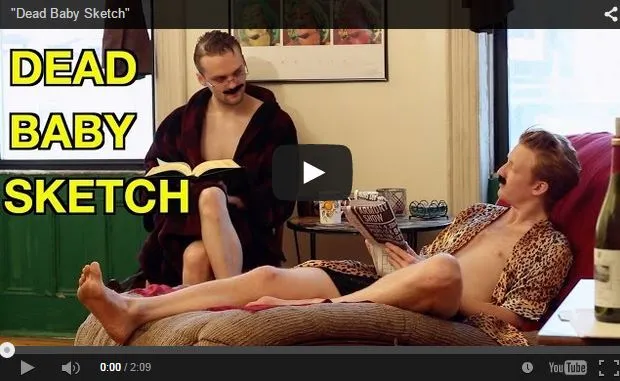
I didn't say it was a tasteful comedic voice.

I didn’t say it was a tasteful comedic voice.

I had a great time this year experimenting with comedic writing. It’s something I used to do when I was younger, which I lost my passion for as I got older and more cynical. Jokes always make it into my films, somehow, but riding off the end of 2013, when I collaborated with The Motel Staff on several holidays videos, in 2014 I decided to brave the waters in a more direct way. This resulted in a few sketches and a five-minute set of stand-up that I did, which was a blast in itself and lead to this post about how I am The Wolf. The effect of all this was that: 1) I proved to myself that I could do it; 2) I rediscovered how much I like making people laugh; 3) I met new people who would prove to be invaluable collaborators later on in the year.

Got Fictional

You too can get a hold on some DREAD.

You too can get a hold on some DREAD.

I returned to my roots in another way in 2014, by writing my first short story in over seven years. In drafting, that short story became something longer than a short story and shorter than a novel . Despite it’s slight stature, A Night Alone in My Dread became a major accomplishment for me. I was not expecting to write fiction this year. The fact that it happened, and that hundreds of people read my little book — I can’t begin to express how grateful I am. To put this in perspective, my creative output took the form of narrative fiction probably 90% of the time for most of my life, up until I started making films almost ten years ago. In many ways, this aspect of the year feels like renewing an old friendship.

Produced, Crowdfunded, and Shot The Videoblogs

Cass (Masha King) waits for an explanation as to how this all happened.

Cass (Masha King) is also waiting for an explanation as to how this all happened. From The Videoblogs.

I don’t understand. I’m being honest with you about this for the first time. I don’t understand how The Videoblogs happened . It’s still hard for me to process, that as I work to finish transcoding and organizing footage, and syncing picture to sound — that soon I’ll be editing a feature film that I wrote and directed, and that YOU made happen because you believed in us.

You’re fucking beautiful. That’s all I can say. What? Where am I?!

Became A Professional

The script for my new project, the story of which, I hope, is just beginning.

When The Videoblogs was just a stack of pages.

I’m not sure when this happened, either. I just know that it did, and that I’m extremely grateful. Why do I feel like a professional, now — when I’ve been “making stuff” for years?

Partially, I think I just started bumping up against “minimum time served”. Ten thousand hours and all that. Another big help was The Artist’s Way . But the biggest difference, I think, came from accepting myself and my circumstances and building my work flow around that.

What does this mean? For me, it meant looking at the reality of how I work best, and what the conditions are that I have to work within, and finding a system that works within those “constraints”. Because I struggle still, on occasion, with anxiety and depression, this system also had to take things like daily mental toll and daily mood into account.

What did I come up with? I write in the morning — something I had never done before. I get up earlier than ever before (usually) and focus on self care for an hour or so and then I write as early as I can in the day. My goal is an hour of writing. If I get through thirty minutes, I’m okay with it, not only because it’s still progress but because, on most occasions, I end up getting more done later in the day as well, which results in multiple hours of progress that probably wouldn’t have been possible without that earlier healthy start.

And I don’t restrict myself to a single project. It’s too much pressure. When I did that in the past, I ended up obsessing and the work suffered. Instead, now, I turn to whatever project or outlet seems to need my attention for that day. In short, I learned for myself what many more accomplished artists than me have said before — that I had to start treating my art like a job. Not only has my art not suffered as a result of this decision — as the above proves — it actually began to thrive. Despite being born and growing up inside the stormy hair-cave that is my head.

Why We Move

I began by saying that I wanted to outline all of that so that I can keep up on my efforts, and also to share them with others, in case my testimony could be of some use. But, getting back to the idea of movement, there’s another reason why I wanted to take stock of the year.

This is far from over.

Much of what saddened and frightened me in recent years is unfortunately still going on in the world today. I’m not going to recount any of it, because I’m not sure any longer that doing so is at all useful.

Instead, I want to keep focusing on movement. On grassroots efforts. Somewhere along the line of shepherding all of the above artistic efforts, this year, I realized something. I realized that nothing is going to systemically change, politically, economically, morally or conscientiously — until I change. Until we change.

So much of life is about perspective. And we’ve truly lost perspective as a society, in a lot of ways. We know it, most of us know it, but we don’t seem to be able to deal with it.

It doesn’t matter how this happened. It doesn’t matter if some of us can talk more confidentially about how it did, or are more certain about how to fix it, or whether you believe one argument or another or none of them at all.

What matters is that we talk through things, so that more of us, in more places, can begin once again to see life as it is rather than what we’ve been told it’s meant to be.

We cannot become empowered until our hearts are full. Our hearts cannot be full until we feel out the pain that we’re in, nationally and, perhaps, the world over. We cannot begin to heal until we’re sure of what’s happened inside of us and begin opening our mouths to speak about it with one another .

This has been a long time coming. We must continue to reflect on hard truths, must challenge each other to look at things differently, must be patient as everyone exerts his or her right to be heard. Maybe it’s all been going on for a long time. Probably I don’t even have a full idea yet of what I’m talking about. But I’m trying to understand . I’m choosing… to hope.

I guess that’s the main thing that changed for me, this year. I realized that I don’t have all the answers, or even any of them at all. All I can do, as an artist, is struggle with what questions call to me in the loudest voices, present that struggle to you, and encourage and engage in a dialogue.

Here’s to more in 2015. Thank you for reading, and I wish you the very best, for all the days of the coming year.

Call for Writers (Quick, Easy, Fun)

UPDATE : This call for submissions is now closed. Thanks to everyone who sent in a script!

—

Hey, folks.

So Rebecca De Ornelas and I are looking for some help with a fun project that we think could also be a cool way to spark some quick and easy collaboration.

I can’t release the specific details publicly, but here are the basics:

  • We’re looking for several original one 10349148_10101298458056442_6565653928597047063_n page monologues (screenplay format) that tell a difficult story in an honest, perhaps even semi-comedic way.
  • We would like to see a strong cross-section of diverse voices submitting (and please feel free to spread the word on that front).
  • We would like to see a strong cross-section of diverse characters (in terms of age, gender, background) in submissions
  • There is no compensation, however…
  • Selected scripts will be produced and delivered to a few different audiences (including mine on this site).
  • Selected writers must be willing to sign a release that grants us the right to distribute the finished product only within the parameters of our project (you’ll get details).
  • Selected writers will be given a final copy of the video and will retain all copy rights to the produced and written material.

Please do not send any scripts at this time. If you are interested in submitting, or would like more detailed information, let me (Michael) know via Private Message on Twitter or Facebook, or via this site . Twitter and Facebook will get to me faster. Please include your email address at this stage. That is how I will get in contact with you.

The deadline for submission is June 30th.

How to F*cking Rest (In 10 Not-Always-Easy Steps)

Zelda has no trouble resting.

Zelda has no trouble resting.

Let’s be clear from the start: I have very little idea of what I’m talking about in regards to this subject. But I’m learning. So, consider the following more of a report on a work-in-progress, than a presentation of any definitive framework.

Only someone like me would view the ability to rest as a work-in-progress — but I know there are some of you out there who have the same problem. Maybe more than a few.

It’s better than failing spectacularly at it, I suppose.

As I have mentioned on various social media channels, I’ve been sick. Again. For over a week. Again.

It could be worse, and I understand that. But it still sucks.

I’ve been making a concerted effort to learn from past mistakes. And, as has been well-documented — on the scale of moderate to severe — there have been plenty of those.

Anyway, for better or worse, as obvious as some of these may be, here’s what I’ve learned about what works — when I follow through. Maybe all of this is obvious to a sane person, but that’s not always me.

1. Accept it.

We all know how this works. The interior monologue:

“Something doesn’t feel right.”
“You’re okay.”
“Probably. But…”
“You need to do X, Y, Z. You’ll be fine.”
“Yeah. But…”

They key is to listen to the “but”. Ears between the cheeks.

“But I’m really not feeling well.”

This (hopefully) allows one to have compassion for oneself. Even begrudged compassion will do.

“Okay. Fine. I guess X,Y,Z will have to wait.”
“OMG!”
“Shut up.”
“It will be okay. I promise.”
“I don’t believe you.”
“You don’t have to — you just have to trust me.”

2. Stay in bed (and/or stick to couch).

I’m historically bad at this. But it’s important. This week I’ve been much better about it than I have been in the past.

I’ve (luckily) been able to establish boundaries with myself in regards to my bed. I don’t work in bed. I do very little web surfing in bed. I really only sleep and read and watch TV and snore in bed.

But I’ve found that even moving from bed to couch has a debilitating effect on my levels of relaxation. It opens the floodgates of distraction. Once I’m out of bed I tend to sit and not lay down. Or I stand, battle myself about standing, and then sit again. I’m also able, from my couch, to view most of an apartment’s worth of “stuff that needs to get done” rather than just one room. So, my solution this time around?

At night, I’ve stacked my bedside table with the basics of what I’d need in the morning to stay in bed for at least a few hours after I wake up. Lately, this has been a stack of comics/graphic novels (fun reads), a bag of cough drops, water, tissues, etc. It’s worked.

After a certain point, though — and as I’ll discuss this more in a moment — it helps to move around. That’s why after a few hours I do a few minor things (with a focus on rest or healing related tasks, such as the brewing of miracle teas) and then I move to the couch.

3. Read.

It gets you out of your head. Sickness can magnify feelings of isolation, loneliness, worthlessness (a good American produces and consumes and does not rest in between) — to a spectacular (not so spectacular) degree.

Reading also passes time and dulls pain by distracting us in an immersive way that’s a bit different than when you watch movies (next on the list) or talk to people (farther down on the list). Reading fiction in particular, when the stories are doing their job well, can be like wrapping your mind in a blanket. That’s not the say the below methods have less value. It’s just different.

4. Watch movies.

If reading is a warm blanket, a good movie is a hearty bowl of chicken soup. What?

It’s strange, and I don’t know how to explain it, but, for me, the magic of cinema is that, even when you’re watching something alone in your apartment on your TV — the experience is comfortingly communal. Some people might argue that point. They’d be wrong.

There’s something about watching characters struggle/explore the worlds they inhabit o n screen — which, again, if the story is well told — that gives you something you can’t get anywhere else. Fiction may warm me but film reminds me, and all of us, I think, that we’re not never alone in our loneliness. And it does this in a more direct, and more immediately observable way, than books can. You can turn away from text, or avoid it. It’s less easy to turn away from even recorded images of human beings, with humanity shining through their eyes.

The benefit to the sick is similar. Loneliness is temporarily assuaged, time passes, pain can be momentarily forgotten. All this together — and the same can be said of books — can also help contribute to a belief that the problem of the illness will eventually resolve. At the very least, some temporary relief can be easily won.

5. Move — a little.

For me, this mostly took the form of short walks down the main drag in my neighborhood. If and when it’s possible, even when you’re sick, it helps to get fresh air. Sometimes, it can’t be done. I wasn’t contagious and a few open windows weren’t cutting it for me, so on most days (but not all) I rested up for a few hours after sleeping a long sleep — and then ambled to the pharmacy or a bodega for supplies.

This helped the loneliness, too. Just fifteen minutes outside, after a day (or days) of riding the couch — it can also (obviously) provide a reminder that you’re not alone, even in your illness. Further, especially in a crowded, punishing city like New York — you also may see people whose current or long-term plight is much worse than yours. Unfortunately true, but this is also an opportunity to take hold of a little gratefulness and/or exercise a little humility.

6. Ask for help.

Ugh. I know. Right?!

I’m not great at it. Getting better. And I have been lucky (more gratefulness on the way).

My wife took over some of my household responsibilities while I was laid up. Sometimes, as I would have had to do with anyone else, I had to ask for this help. No one knows what you can or can’t handle, for the most part, unless you tell them.

Sometimes, our nearest and dearest know us better than we know ourselves — and we don’t have to ask. Still, I’ve found it helpful not to make too many assumptions in regards to this point. This is particularly true when it comes to work.

For the most part, even for those of us whose jobs technically overlap with others in terms of responsibilities — we all specialize in some way. If not, we at least still own responsibilities that are ours only, in terms of workload. Work life, as it should be, is more officious (duh) than home life, at least in such terms. It can be easy to convince ourselves to push through with work while ill because the process of explaining how to do what we do, exactly how we do it, seems daunting.

This is understandable. But temporarily letting go of responsibility can also be treated as an experiment in trust and in leadership. These are two aspects of life where daunting is often the word of the day, but which also can deliver rich rewards to those willing to confront fear and hesitation.

Sometimes asking for help means that someone else has to cover for you — and that you, in turn, need to cover for them, now (in terms of communication and guidance) and/or in the future (in terms of fairness). This all takes a little bit of acceptance and some patience. I’ve found that it can help to have a plan, as well.

Anyone can take the time, when they are healthy, to summarize (on paper or through conversation) the basic and/or most important day-to-day responsibilities that they own — especially when it comes to actionable tasks. Not only does this leave you with a manual to help people help you, it can also serve as an informal self-assessment for judging your own efficiency, and/or finding areas of responsibility that can be streamlined, and/or work flows that can be updated.

7. Talk to people.

This is another hard one for me, because, basically, it’s another form of asking for help. More than a couple of days in bed will leave anyone feeling lonely and miserable. So, sometimes, we need cheering up. Again, I’m lucky to have a spouse I can talk to, and who continually asks me to talk to her ( ugh ). Still, it helped when people checked in. And even though I sometimes didn’t feel like talking — or reaching out — I did. A little. I know I can still be better about this.

No one gets worse by communicating. Even brief, random discussions with neighbors, on my short walks, made a difference to me. When we feel we are at our worst, sometimes it takes the reflection of another’s impression of us to realize that it’s not as bad as all that.

8. Look on the bright side.

I know.

But there always is one. For me, this time…

I had been trying all month to rest. Even before I got sick. I was doing an only-okay job of it. Now I’m being forced to rest, and, honestly, despite all of the above — it hasn’t been that bad.

Drugs help!

But, seriously.

I’m not saying my body hit the shut down button just because my brain wasn’t playing ball. It’s a possibility, but it doesn’t matter. I’m sick and it sucks. But I also got to read some books and watch some movies that I probably would have found a reason not to watch under “normal” circumstances. And part (or most) of what’s ailing me has been a sore and swollen throat. Enter excuse for copious amounts of sorbet and ice cream.

Yes, I have gotten a little fat. But I’ll handle that.

This time off my feet has also allowed me to do some healthy thinking. It’s always a pleasant surprise, and an interesting development, to find myself sick of body and then, suddenly, simultaneously, mentally thriving. It’s almost as if my brain relents in terms of self-flagellation, temporarily, out of respect for some amorphously defined threshold of pain and uneasiness that it feels it should back away from when my body is picking up more of the slack.

The thoughts slow down and they get less dark. This is more of a recent development, now that I think of it. Sickness used to make me very angry. But I question most of my initial impulses towards anger, most days, now.

There’s probably a lesson in there somewhere. Right?!

Moving on…

9. Complain.

Yes. Do it.

I’m telling you. Let it all out.

You have a right. Don’t go crazy. Don’t assume you also have a right to be public and unrelenting about it — but complain.

Someone will listen to you. You may exhaust them. This is understandable. Move on to someone else, if you aren’t done. Someday, very soon, someone will complain to you. Maybe as soon as tomorrow. Maybe its me, right now.

Oh, but don’t listen too much to other complainers if you’re still sick. Wait until you’re better.

And one last, important note. Don’t listen to people who complain about complainers.

You know who I’m talking about. That one or two (or more) folks who troll Facebook or other social media channels griping about how annoyed they are at other people who are simple expressing their emotions.

Can it get to be too much? Yes. Anything can. Everything within moderation. There are lines.

But, sometimes, if you’re sick, or if something shitty happened, or if your life sucks…it can feel good to just cast your despair into the world. No one has to do anything about it who doesn’t feel so compelled. Contrarily, they can also tell you to shut up — and then it’s up to you to decide if this is okay or not.

All of it, though, is better than bottling up that despair. Despair is real and it’s tangible and it’s got to eat somehow . Don’t let it eat you. Send it out in small doses to your friends!

For real. We’re hard-wired to sympathize, even if these days we need to click a link to some inspiring video to be reminded of the fact. Getting the complaints out starts killing them before they even reach your friends. Despair doesn’t fare well in the air.

So, there. Claire.

10. Adapt.

This final step is more of a catch-all of all the others.

Rest isn’t doing nothing. It’s doing something non-stressful, something other than working. And I say that using a loose definition of the word “work” — because even thinking can be a lot of work. In fact, as I hinted above, it often is .

Taking time to rest requires us to do something that has become dangerously taboo in contemporary America, and that is to acknowledge our humanity. Our frailty.

We’re surrounded and infected by so many rules. Some of us, people like me, even have some rules — some unhelpful and corrosive rules that make no actual sense and only cause more damage — twisted into our DNA.

But the thing is, as we all know very well — life does not follow rules. Sometimes we get sick. Sometimes, people die. At other moments, everything in the world appears to come to us easily, and it feels like we’re riding a wild unicorn on a beam of white light (or some other metaphor).

The point is that we can never know exactly what to do, and how, or when. We can only listen to our bodies and our minds and our hearts, and do our best.

In between, we rest.

Like my style? Subscribe to my list for advanced/exclusive (and free!) access to new (creative) content produced by yours truly. I send one email per month. Sometimes, they’re even funny. At least, I hope they’re funny.

3 Simple Steps Towards A Successful Indie Film

A production still from Multiverse, our current short film.

A production still from Multiverse, our current short film.

It’s been a bit of a struggle, lately, getting ready to make my new film. The jump to a feature from shorter content is a big one. Not that the small films have felt small. Things have a tendency to feel big to me no matter what size they actually are — this is a default reaction I have to sometimes work to temper — but with something as potentially overwhelming as the planning and implementation of a complete feature film, there’s no arguing the facts.

This is big.

That being said, I know that I can’t allow the size and weight of such an endeavor (or any endeavor) to overwhelm me. I know, as I have mentioned before , that I can only put one foot in front of the other.

I also know that a story is a living, breathing thing that can’t only be built, brick by brick, like a house.

What I mean to say is that I do not believe the successful execution of a film rests completely in doing a little bit of work, day by day, until it’s done .

I would think there are very few forms of artistic expression that work in this way only. A screenplay, yes — but a screenplay is not an end format. A novel, perhaps. But in the prevailing terms of success, the work of novel is not finished just by its completion. There must be readers, and, by this measure, more novels and then more readers.

The same can be said of almost any artistic endeavor, any product-consumer relationship (the artist/patron relationship is a product-consumer relationship), the end result of which is a desirable level of distribution or sales. The painter paints each day until he or she is done, and may keep painting for as long as the desire is there. But, invariably, there must be an audience. The alternative is obscurity and to me, in the long term, however unfair the presumption may be under certain rare circumstances — obscurity represents failure. A failure not just to “sell” but to truly connect, which is almost always the reason we start making art and telling stories in the first place.

So I have spent the last several years learning. I have written script after script until I got to this place, where I feel like the measure of the success or failure of any one film of mine is going to be owned more by the appropriateness and accessibility of its themes — and my own exploits to find people who wish to consider and discuss such themes — than the execution of its story. I’ve similarly spent enough time behind the camera, by now, to be able to say the same about technical execution and world building on set with select cast and crew.

I know I can do this. Still, obviously, there are doubts. Just this morning, I woke up, got out of bed, and the first coherent thought that passed through my mind was:

“Fuck. There’s no way I can do this.”

I learned over time not to listen to that voice. Actually, that’s not entirely true.

You would think ignoring the voice of doubt would be the way to go, but the best approach (in my experience) is actually to nod and listen and then refute. The fear behind the doubt is real. But so is the determination and the confidence that does return if and when the opposite is reasonably voiced — with compassion.

“I can do this.”

What this has to do with the majority of the above is simple: I am finding that, as with most things — there is (must be) a middle.

I do have to take small steps, every day. But I also have to respect the film’s need for overall guidance. This is especially true for ground-level independents like me. I’m not entering into this project with any goal other than to do my best and share it with you.

You , specifically. The kindred of The Furious Romantic. You are the people I truly care about — whoever you are, wherever you’re from, however we know each other or whether or not we do. That is another truth I have to constantly remember, and could do a better job of remembering. It gets hard sometimes, with all the noise we are constantly surrounded by (or that we surround ourselves with). There’s a loneliness that comes with sourcing out, alone, what a story needs. There can be a further loneliness in shepherding a film through development and preproduction until everything crests beautifully with collaborative energy on set — and then ebbs and flows with diminishing energy as distribution runs its course and the first and most vibrant (perhaps only) lifetime of the endeavor fades away.

So, last weekend, I was thinking about all of this and wondering what to do. As you may know , I’ve determined to pursue a balanced life in parallel with this project. And perhaps it’s a testament to just how far I’ve come in my own personal and artistic development, but I was able after a few days to temper most of the aforementioned fear (there will always be some, and it will always come and go, ballooning and shrinking and ballooning again) by jotting down the following three steps.

They didn’t come from nowhere, and they aren’t original, but I’m sharing them because I believe they can be universally helpful in their simplicity:

  1. Have a plan.
  2. Keep working.
  3. Adjust as you go.

Is this list overly simple? Not really. I could easily slot in a few more steps (test, measure, analyze were candidates) but the point isn’t to form a prescription so much as an ultimate guide that begins with the presumption that — this is important — the film is going to and must happen regardless. The planning and adjustment are the protective flanks to the work, which is not usually a problem if you’re making films for more than a few years. It’s always going to require a lot of work.

The script for my film — which I’ll name for you, soon enough — has been done for about two weeks (until I dive into it again for another quick draft). I’ve spent the time since steeling myself for what is sure to be a hell of a ride, but also steeling myself to remember these three simple steps .

I believe that implementing the wisdom contained within these guidelines, from many different standpoints but one base, will take me (and my eventual team) a long way towards the successful completion of our goal — to not only make something great but get it to you, and as many more additional kindred that may be out there as is possible.

Exemplary quality (in no specific terms) and an eager audience. These are the twin challenges for today’s independent artist — or even today’s artists in general. They aren’t unique to our slice of history, and perhaps it’s time we stop pretending that they are.  We must make good art, and we must get it “out there” if we are to do it all again. The process must be arranged smartly, to the benefit of all, within the constraints of reality but with an eye on a better tomorrow in all terms. For this to all go well, again, work must be done. But just as it must be done in one direction, with one guiding voice, in order for the film itself to flourish — so too must this be done from the standpoint of career sustainability. It doesn’t necessarily have to be the filmmaker who holds this responsibility but it should be somebody who cares about him or her and the vision he or she serves from project to project.

Translation: It’s not enough to just have a film anymore. And perhaps it shouldn’t be. There must be a plan, for any filmmaker or artist who wishes to keep working and to perhaps become increasingly empowered, and it must wrap around the entire life of the project and, in a way, across projects. As long as we keeping working and adjust as we go — and do this in almost any way but a blind way — progress will be made. Step by step, yes. But in a unified direction with ultimate touchstone goals that do not contradict the artistic process but, rather, ideally, help it flourish.

It’s a strange — but exciting — time to be creating. I have said this before . Much has been observed, much more needs to be tested. It can be done. I’m going to try to do it.

There is, as they say, only one way to find out whether what I have planned is going to work.

So, soon — we ride.

Like my style? Subscribe to my list for advanced/exclusive (and free!) access to new (creative) content produced by yours truly. I send one email per month. Sometimes, they’re even funny. At least, I hope they’re funny.

5 Daily Questions for Maintaining Creative Productivity

This an example of me acing Question 5: "Am I taking time to enjoy life?"

This an example of me acing Question 5: “Am I taking time to enjoy life?”

This January, for essentially the first time, I made a New Year’s Resolution. Two, actually. I decided to set two goals for myself, both of which were born out of my primary obsessions for most of the second half of 2013.

I want to finish at least shooting a feature film before the year is done, and I want to maintain at least a semblance of a balanced, healthy lifestyle while I do it.

Anyone who makes art — or who does any sort of project work in particular — could and would probably tell you that these are ambitious goals. Independent filmmaking in particular, with our lower budgets and our seemingly always empty pockets, puts a great deal of pressure on the human mind, body and spirit. It does this all the time, but the toll is especially great in the months leading up to production. Production itself is often a matter of pushing limits in ways that are perhaps sometimes celebrated, and which we can of course be proud of in retrospect, but which simply are not healthy in either the long or short term. And then there’s the post-production period, which often leaves us facing long recoveries. Physically, mentally, emotionally, spiritually — even the addict’s rush that comes with having created , it doesn’t last. The truth is that making art depletes us.

Much of this is unavoidable, especially in the earlier years of a career, as we’re learning the ropes the hard way, as we invariably have to do. But, speaking as someone who has pushed myself too far in the past, I have to honestly say that I have come to the conclusion that, without balance, even art that has been hard-earned — it invariably suffers as we suffer by it, if and when we aren’t careful with ourselves. Limits can be pushed, but they also have to be respected.

For Example: One of The Times I Kinda Lost It

I arguably risked my life one day, for one of my films. Matters of budget and inexperience had led me to a place wherein I had to get my sound mix from New York to my editing bay (basically, a laptop set up in my old childhood bedroom in Rhode Island) — after 12 hours of work with our re-recording mixer. The film was set to premiere in a few days and wasn’t finished. I ended up making the drive alone, after having been awake for almost 24 hours. Towards the end, despite a surplus of caffeine, I couldn’t keep myself awake. It was three or four in the morning when I called my parent’s house (where I was living while making the film) because my fast-asleep fiancee wasn’t answering her cell. My brother picked up. I told him I needed someone to talk me through the last 45 minutes or so of the drive. It was that close. I had caught myself falling asleep at the wheel a few times.

Should I have pulled over to sleep? Possibly. There were a lot of things I should have done. Either way, when my phone battery died after about twenty minutes or so of conversation with my brother, I got desperate. I started talking to myself — loudly. I blasted the radio and opened all the windows and sang loudly. It didn’t matter that I didn’t know any of the words to the songs that play on the radio at three in the morning. When I couldn’t sing any more I came up with a sort of mad mantra, and repeated it and repeated it and repeated it. I rolled down all the windows in the car to let the cold November air inside. In short, I lost it. I went a little crazy. It’s perhaps a little funny now, but at the time it scared me — even if I didn’t admit it scared me.

How To Avoid This?

You can see why I’m eager to not repeat the same mistakes I’ve made in the past, when it comes to navigating the difficulties of making good stuff on the cheap.

As has been pretty well-documented here, I’ve come a long way as an artist and as a person since those days. I’m not even sure I would get to that bad of a place again even without my goal of balance. But I’ve come to treasure what I’ve built for myself these past few years. I still struggle with the repercussions of continuing to fight the good fight, and I still have to wrestle incrementally with my demons. I just lost a small battle to fear and doubt last night. Today, I’m all right, even though I know it will happen again. The key is to take things in stride and to avoid an avalanche.

I can’t afford to fall to madness, at any point, as I get closer to initiating my plans for making my new film (which you’ll hear about soon enough). The endeavor as a whole is going to be hard, and at times it’s going to be a legitimate struggle. I know that. But it’s also something I have to do. I have to make this film. I can’t let this need destroy me.

So, what can be done? What can I do — what can we do — to protect ourselves and our projects from the sometimes debilitating effects of long-term creative pursuits? Similarly, what can be done to protect our long-term creative pursuits from their own debilitating effects on our lives?

I think the answer is no different on the project level than it is on the macro level, as we strive continuously to live another day as artists in the real world .

Here’s what I came up with. Most of this is borrowed.

The Questions

Since the beginning of January, I have asked myself the following five questions at least once each day. Lately I’ve been trying to do this two or three times.

  1. Am I taking care of myself? It took my years to realize that I’m not good at self care. It took time and some outside help and it’s still sometimes a struggle. While everyone is different, I do believe that Americans on average — we don’t take great care of ourselves. Additionally, artists tend to be born out of complicated circumstances — not always, but much of the time. It’s important to my well-being and to my productivity to take care of myself, and to remind myself of the importance of self-care, everyday. How do I do it? Through reflection, meditation, and action. By action, I mean I try to do nice things for myself, no matter how small. Most of the time, this means taking a break or a walk or stopping everything to drink a cup of tea (it works). On a larger level, it means eating healthy on most days and getting enough sleep on most days. Sleep. Is. Huge.
  2. Am I avoiding the important? This is adapted from Tim Ferriss, who recommends in The Four Hour Work Wee k that we ask ourselves a variation of this question a few times per day (“Am I inventing things to do to avoid the important?”). I have long had my phone set to ask me Tim’s version of the question in the morning, the afternoon, and early in the night. It helps me keep myself focused. A lot of times, I ignore the reminder, because I know I’m on track. Sometimes, I growl at my phone, because I am not on track. Usually, this means I am afraid of something. However understandable the fear may be, it’s almost always in the way of “the important”. That won’t do. Also, an additional note: while this may not align perfectly with the spirit of what Ferriss advocates, sometimes, for me, “the important” is not a project. Sometimes, it’s self-care, or my relationships, or –more on this below — enjoying life.
  3. Have I taken a step towards my goal of making my film? I don’t care how big a step. Every day, I make sure to do one thing to move my current project forward. Sometimes, it’s just sending an email. Sometimes, it’s research. It doesn’t matter. Any tiny thing I do on any one day brings me one step closer to the larger realization of my ultimate goal. This can be easy to forget, when fear creeps in and all we can think about is the overwhelming list of tasks that must be completed to make a film, that are standing in the way of it being finished. This point of view doesn’t work. Trust me, if you aren’t already nodding your head. It’s a trap set by self-sabotage. However a big task gets done, and by whoever — it’s always a matter of steps. We don’t magically float to the top of a tall flight of stairs by staring up at them worrying how we’re possibly going to walk all steps at once. We get there, in time, by putting one foot ahead of the other until it’s over.
  4. Am I being open in my relationships with others? This is perhaps a question that’s aimed more specifically at where I am in my life right now, but I’m sharing it anyway in case a few people might benefit. Also, the question itself necessitates I mention it. Basically, I feel I’ve spent too much time holding back certain parts of myself (again, out of fear) as I’ve interacted with other people, throughout my life. Life goes more smoothly (and my work goes more smoothly) when I kick this propensity and endeavor to just be me. Focusing on openness, I have found, also helps hasten decision-making. I don’t labor over decisions or create as many scenarios in my head when I’m being open with myself and others. I’m able to more fully live in the moment. Daily meditation and informal studies of mindfulness and Buddhism have helped me immensely in this respect. Openness has numerous benefits. There’s room for tact, of course, because not everyone needs to know everything about everyone else, and we all need to protect ourselves sometimes — but I think we’ve suffered enough as people and as a society from the effects of leaving feelings unspoken. The repression isn’t healthy.
  5. Am I taking time to enjoy life? Save the best for last, right? I unfortunately need to remind myself to stop and enjoy life. I tend to work too hard. I tend to brood, when I’m not working. There is not much room for naked enjoyment in either of these default states. Even work that makes me happy — it’s still work. So I have to ask myself this question, at least once per day. When the answer is “no”, I do what I can to correct the situation. Sometimes, again, this means a cup of tea, or maybe a soda or a snack. Many times, it means taking time to read some fiction, watch a movie, or listen to a podcast. Anything that isn’t work and gives me pleasure. That includes going out. I will force myself to go out when I don’t want to, because I know by now to mistrust the feelings and thoughts I get that tell me to do the opposite and stay home and work or brood. Balance has to include joy, for me.

So, there you have it.

Hopefully, some of the above has been helpful. I’d be interested to hear what others are doing to maintain some semblance of balance while working through large projects (I include life in this category). Hit me up in the comments if you have anything to add, or any further questions about how I came up with this list in particular.

Like my style? Subscribe to my list for advanced/exclusive (and free!) access to new (creative) content produced by yours truly. I send one email per month. Sometimes, they’re even funny. At least, I hope they’re funny.

How to Make Art in The Real World

This is a terrible To Do list for an artist. But a perfect one for cold winter days.

This is a terrible To Do list for an artist. But a perfect one for cold winter days.

Hello, Furious Faithful.

Welcome to the Inaugural Guest Post on mdibiasio.com. I’ve got a busy couple of years coming up (mischief is in the making) but I want to keep up a dialogue in between potentially more sporadic posts from me — so you may see some more entries from guests as the year continues. I’m especially busy for the next month (planning of the making of the mischief), but will still chime in now and then and I’ll probably do what I’m doing now and introduce and comment briefly on guest material.

Now, some info on our guest writer, Liam Billingham.

Recent posts about navigating life as an artist and indie filmmaker have been popular here, so when I noticed the below-mentioned conversation on Facebook — and read and enjoyed and agreed with many of the points made — I reached out to Liam to share his findings and his thoughts.

I first met Liam during a Seed&Spark Twitter chat, which, incidentally, you should check out if you’re a filmmaker and if this sort of material is of particular interest to you. Seed&Spark has been bringing great energy to the discussion and growth of a rising movement towards empowered, sustainable and self-directed indie filmmaking, offering support that ranges from crowd-building to funding to distribution, and their momentum and influence seems to really be growing. I’ve enjoyed becoming a part of their #FilmCurious community (the hashtag used during chats). Anyway, Liam is an indie writer/director living in Brooklyn, who recently finished a short film and is developing his first feature. Since I’m in the same position, more or less, we realized we had a lot in common and have become friends.

All of the below came out of an informal poll Liam took on Facebook, asking for some added insight from other seasoned artists in regards to providing advice to college seniors in the arts who will be graduating this year. I agree with all of what came up in the conversation, and believe many of the observations and advice shared by Liam’s friends can be of value to emerging and established artists as well as those who are nominally in more of a beginner’s position.

I’ll leave it to Liam to contextualize his specific findings. The reasons why I asked him if he wouldn’t mind sharing them, for the benefit of all, should become readily apparent as he works through each.

In spots, I’ve made some personal notes, which appear in italics and are tagged in the front with my name. All remaining text is from Liam unless otherwise indicated by him.

—

What’s Next

Just before Christmas, my former undergraduate theatre professor at the University of New Hampshire asked me to Skype in to a class of graduating seniors and talk about my experience as an artist since graduating. Specifically, the topic was ‘What Next?,’ and dealt with looking at the journeys alumni took that led to where they are right now.

The morning of the talk, I decided it was best to poll a group of friends and fellow artists who had been making art since we graduated. I didn’t want to restrict the poll to UNH alumni. I wanted to cast as wide a net as possible. I didn’t want to just ask theatre people only, either, since I don’t really work much in theatre anymore. For these reasons, I turned to all my Facebook friends in asking for advice for seniors.

The post got a lot of traction, and we got about 40 comments, most of which were incredibly useful. Reviewing what was sent in, a few key ideas popped up that I thought I’d share:

The More You Know…

From Stage Manager Natalie Lynch: “Do as much as you can and learn as many skills as you can. The more you know the more areas you can work. And you never know what may be asked of you…”

From UNH Student Engagement and Young Alumni Programs Director Megan Hales: “…ask as many questions and talk to as many people as possible. Sometimes you don’t know what you don’t know and the only way to make progress is by talking to people!”

The More People You Meet…

When I was at UNH, I had an intellectually challenging professor named David Kaye, who turned me on to Anne Bogart and the SITI Company. I read Anne’s book and applied to train with them. At their month-long training program in Saratoga, I met Jean Ann Douglass, whom, years later, introduced me to Nicholas Nelson and Jared Mezzocchi. Nick has been a constant collaborator, and Jared introduced me to Ben Jaeger-Thomas, who has been a client and collaborator for the past few years. Both Jean Ann and Ben comment below on how to make it as an artist. They’re lifers, fully committed to making art a part of their lives.

The more people you meet, the more you learn, the more experiences you have, the more these wonderful people will feed you. (MICHAEL: And you, them. In my experience, after I have summoned up the courage to “butt in” on someone, particularly online (though I do it in person as well) and open up to how I’m feeling about whatever they said or did (in a positive and/or constructive way) and then offered help — down the line, they’ve offered to help me too. A simple and obvious lesson but one that can be easy to forget). You’ll also meet assholes. You need to meet those people too, so you know you don’t want to be around them. (MICHAEL: This is a very good point. There are unfortunately a lot of negative people, in every industry. Negative artists can be particularly damaging to your progress and momentum. I should know. I used to struggle against one who used to live in my head, and still does — behind a series of locked doors).

From actor Jesse Presler: “…foster artistic relationships outside of your comfort zone. It can be an artistic hindrance to only spend time with people who speak the same artistic language in which one is indoctrinated. It can be a hindrance to personal growth to only spend time with and hide among one’s recently-graduated friends. College comrades are very important, of course, but part of being an artist is growth — growth which is and should be uncomfortable, painful at times even.”

So, find your people.

Carve Out A Life Course

From Seven Stages Shakespeare Company Artistic Director Dan Beaulieu: “Go out and see as much as possible. Now that classes are over, take 15 hours a week and carve out your own “life course”. Shows, concerts, movies, art exhibits, artisan craft fairs, anything creative. And read! And read. And read.” (MICHAEL: This is fantastic advice, that I whole-heartedly agree with. To me, it speaks to the importance of immersion. Personally, I long struggled with a tendency to explain away reasons why I don’t have the time (or, worse, don’t need to take the time) to do my due diligence as an artist and do as Dan says and “go out and see” stuff. A few additional added points: 1) Don’t wait for perfect circumstances when choosing what to do or not do, just be open and experiment and allow yourself to be led from there; 2) Be wary of the line between immersion and avoidance; 3) Apart from reading, mix in a healthy dose of private creative consumption. There’s even a difference between seeing a movie or a play with friends, and experiencing it privately and then talking — and doing the same thing but having another hour or more to process before the conversation.)

From Artist/Fractured Atlas Insurance genius Jean Ann Douglass : “Also, don’t kid yourself that you’ll be able to make rent off your art. There are lots of ways to make money, and they all have trade-offs. Irregular paychecks may be more stressful than the confines of working 9 to 5. Or vice versa.”

And, again from Jean Ann: “Don’t burn yourself out before you’re 30 years old. Taking care of yourself as a whole person is the most important thing you can do.”

Adaptation

From Voice over Artist/Actor Ben Jaeger-Thomas: “Really think about what it is realistically that you want to do in the arts. Being famous isn’t specific enough. Are you going to be okay
being on tour six months out of the year, every year, to piece together a living? You aren’t 20 forever.” (MICHAEL: Another good point. I’ve been trying hard lately to not only focus more on “the work,” but on how my work fits into reality . Accepting reality and adapting to it can be so much better for us as artists than we may think when we are following fear-laden trains of thought that tell us conditions need to be perfect).

Take Risks

From artist/musician/graphic designer/filmmaker Ken Nash: “If it doesn’t scare the hell out of you, it’s probably not worth doing. Set a goal each year to do one thing you’re completely terrified about doing.” (MICHAEL: He’s right. I would add that, invariably, what scares us the most can often produce our best work, if not directly — in some way or form at least).

Don’t be a dick

From filmmaker Chris Ungco: “People will respond better to good ideas from people who seem like good people. You get more, and you live better by not being a dick. Good luck.” (MICHAEL: This can be a hard piece of advice to adhere to, as time goes on and the (understandable) propensity for bitterness grows. Adhere to it anyway. Toxic people invariably release their poison to disastrous effect, even if they succeed in a short term way. Further, while we of course always want every single project to be the best it can be, acting monstrously towards collaborators (or worse, to or in front of potential audience members) endangers or destroys future prospects. Finally, in my opinion, no piece of art is worth the cost of dehumanization — in terms of what damage you could do to yourself or others. “Don’t be a dick” could also be translated to “be human”.)
So what did we learn?

  • Being an artist takes time, and it shouldn’t ruin your life. Have a life.
  • Constantly go out and meet new people, learn new things, and find a new niche.
  • Treat people right. Seriously, don’t be a dick.

I think the most important lesson is to really evaluate where you are right now. If it isn’t where you want to be, don’t beat yourself up. Make changes, slowly but surely. Once you’ve started making those changes, you’re doing it right. Being an artist isn’t a race. It’s a long, slow walk forward.

—

Liam Billingham
Liam Bilingham is a filmmaker and media educator in Brooklyn, NY. He’s currently developing his first feature film and working on several short-term projects. He’s just starting up his own blog, ‘Somewhat Suspect’, on his website, liambillingham.com .

Enjoy this post? Please Subscribe to my list. I send one email per month that highlights popular content on this site and provides updates on my film work and other projects. I also give presents to my list, in the form of advanced/private access to new content.