Category Archives: Existentialism

When The Panic Goes

Me, in The Shadow World.

Me, in The Shadow World. Waving “Hello”.

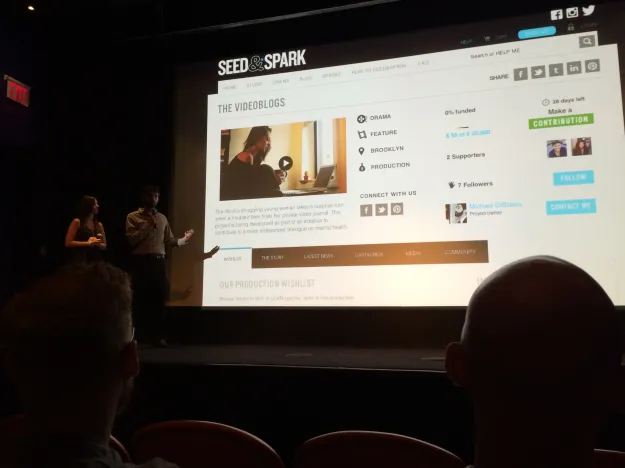
I’ve been reflecting a bit, lately, on where I’ve ended up — in my life and creative career. In many ways, things feel good. The Videoblogs is in post. I’m still proud of Multiverse . I have a new script in the works that I’m very happy with even if I’m also, as usual, terrified of finishing it.

Dreams are beginning to materialize into goals. This is good, because goals can be whittled down, aimed and launched.

Multiverse has launched and landed. The Videoblogs is in the air, even if its riding a slowed-down trajectory warped by limits of time, budget, scope, intention. This new project feels especially sharp in certain terms, but it’s shaped differently than anything I’ve ever done before and I don’t honestly know how or if it’s going to fly. Beyond that, it’s been a fun project to develop.

But, sometimes, I still struggle. Freeze up. I lose faith, or clarity, and I’m left feeling like nothing is going to work out. I feel stuck. I get depressed.

I know that this is normal, by now, when you’re pursuing a path through the arts, and so I don’t (usually) obsess over things at such times. Yet these reflections, I think, have also revealed something new, recently, that I hadn’t noticed before.

Even when things get tough, now — I don’t stop working.

In fact, I’ve arguably felt more dedicated, more focused. I feel a presence within myself that is both new and old, gently pushing me to at least get a little done each day. The old part of me approaches the task with innocence, reminds me that creativity feels good. The new part reinforces the idea that any progress is good progress, and kindly reminds me to appreciate my own work.

One recent night, this combined presence made me stop on the way home from work and put an hour in on revisions of the aforementioned new script.

That hour calmed my shit. And I moved the script forward.

It used to go differently. Historically, I would have tortured myself with excuses, and/or imagined difficulties. I would have lasso’d or found my way into the middle of any drama within radius, so as to have a reason…to run. I would run until a sense of separation from myself (which is what happens when I don’t write in particular) grew too unbearable, whereupon I’d finally capitulate to the intense need to keep creating .

Then there would be a writing binge. Accompanied by other binges.

Things are different now, and I wanted to share these thoughts because I’ve had to remind myself of why and how I’ve felt different, lately.

I have come to treasure a new, simpler relationship with myself, and my craft as it relates to that self. As a result of the last several years of trying and failing and learning, both in career terms and personal terms, I’ve come to feel protective of this new perspective and process. It’s not perfect but it’s less complicated .

I still feel anxious . The dread still comes, in waves. But, increasingly, I don’t panic .

Just a few days ago, someone was panicking (and directing his panic at me) and…I just didn’t want anything to do with it. He was worried about something, which was his choice. He asked if I understood why he was concerned. I said that I did but that I just didn’t feel like panicking about it. The conversation ended when he literally walked away.

I’ve felt that brand of anxiety before — still do, sometimes — and I sympathize with anyone who feels he or she can only proceed that way in order to get things “done” or “fixed”. But I’m learning there are other ways — asking for help, and/or expressing our fears major among them.

Panic used to be the only path I knew to take on my way to work. Now I’ve embraced other paths, like routine and patience.

I don’t miss the panic. I embrace, instead, the steady, daily urgency . But this is not to suggest that it’s always easy.

Say what you will about panic, but it does get people moving. I don’t judge myself for the years of fuse-lit stress. I had a lot of pages to burn through that just needed to be burned. Similarly, I think I needed to live fast for a while…maybe…just to keep on living. The way that it’s gone was probably always the way it was going to go, for me.

And even now, when the panic goes, it can become disorienting. After all, if all we ever know of forward motion comes from being driven by panic, how are we supposed to know how to achieve the same effect, once calm begins to assert itself in our lives? Won’t the whole system come crumbling down? Won’t a steady pace feel unnatural, slow, wrong — when we’re used to speeding, dead-ahead, towards The Goal?

Well, yes. Though, in my experience, the process of destruction and re-creation isn’t always so dramatic as it feels it’s going to be when we theorize about it at times of anxiety. This is mostly because, as I established above — we aren’t actually speeding in a straight line, when we’re panicked, are we? We’re speeding, then screeching to a halt, then pivoting and changing directions, or turning around, or attempting an impossible back-flip, or any combination (or repetition) of all these things.

In this way, panic’s false promise reveals itself. Panic isn’t the tonic it purports to be. It offers unspecific, largely unfocused perpetual motion in the guise of A Way Out. The insidiousness of the compact is that, while panic has you launching and twisting and starting and stopping — there’s no way to tell for sure whether or not you are in fact heading in the wrong direction. It wasn’t until I accepted that I had been “moving” too long without arriving anywhere, until I began learning to subsequently pause and look and listen and inquire — about myself , as I would any other external influence in my life — that I began to realize my “error”.

When the panic goes, we can take advantage of the resulting calm to begin building something more permanent, something that couldn’t have structurally withstood the sharp redirects or the sudden snapping halts that used to characterize our panicked state.

The change isn’t painless. Some days, I feel like I’ve lost a friend.

Panic drove my survival for so long — arguably drove me to write and to create in the first place. Sometimes I even give panic a call on the old land line and we end up hanging out, because few things ends perfectly — and then I wake up with a hangover or a foreboding sense of disappointment and I remember why it’s better for me to make the decisions about what to do and for how long.

The tricky things about panic is that it doesn’t come from a bad place. It comes from an understandably human place — a place of fear. But then, because of fear, panic leads us to a place that at its worst is assuredly bad, and at its best assuredly not good.

And, finally, panic has a charge to it — doesn’t it? There’s a bit of a high that comes with the sense that The Situation is Desperate.

But the reality is that it’s usually not. And the high gives way to a crash, and maybe, yeah, in the end you have a stack of paper or some other Piece of Art — but at what cost? And is it possibly as good as it could be if our truest, most focused self wasn’t completely engaged in its making?

I don’t buy the “necessary suffering” line of thought. Especially not anymore. I get that a hard life, that hard times — they often bring dynamism to the lives of people who subsequently (if they’re lucky) end up feeling compelled to expunge what they’ve experienced, absorbed and processed via some form of art. Having been through this myself, I get that panic is often going to be the first car to pick you up on the road.

Still, as I get further from a place of panic, I am coming to appreciate other, purer, more natural ways of proceeding through life, as I follow what compels me.

I try to write every morning, now, six days a week. Sometimes, it’s still hard, and I end a day without having gotten much done. But every page that gets written, every minute spent on a film, is one more than nothing, which is more than I was able to get done on a daily basis during previous years of my life that were ruled mostly by panic.

When the panic goes, I remain. That can be scary. But it’s real.

I like that it’s real. It makes me happy, much of the time. Even when it doesn’t — there’s at least no regret. And a bonus to all this is that panic finds it increasingly difficult to find new footholds the further I get from the belief that I need it.

I’ve been worried, over the course of these last few weeks, about not feeling panicked. I questioned my dedication, the righteousness of my projects, my points of view. I returned to constantly-revisited patterns of wondering who or what I was, in the broadest terms, because, despite all of the above, the distorted lens of panic has warped my vision after all these years. I struggled to understand how I could say that I cared — if I wan’t panicked.

And then, slowly, one routine at a time, I began rededicating myself to pause. I’m still struggling with it a bit. I probably always will. The whole process has and will continue to take patience.

At the moment, I understand this. I’ll probably forget it next week.

But that’s okay, too. I’m going to continue to worry, I’m going to continue to get anxious. Dread may come and go.

But I don’t have to panic.

—

602066_10100681300095942_1773576913_n (2) Like my style? Subscribe to my list for advanced/exclusive (and free!) access to new (creative) content produced by yours truly. I send one email per month.

The Videoblogs: Why We’re Doing It (10 Reasons)

It's on.

It’s on.

My first film was a crime drama about a thug whose past mistakes catch up to him. My second? A crime drama about a two detectives and a confessed murderess who go up against a corrupt district attorney. Multiverse is as much scifi as it is drama — although as you can hopefully see there’s a lot more going on under the surface than what is presupposed by constraints of genre.

My point is that, if I wanted to, I could go out tomorrow and make something that pulses and thrills. But I don’t want to do that. Not yet. Very soon, I may want to do that, but not now.

Here’s why I want to do something else . In ten reasons, boiled down.

Here’s why we’re making a tiny, quiet film about mental health and reaching out through The Screen — about starting off painfully alone and ending up surrounded by friends — instead:

  1. This is how we feel. Feeling is everything . I used to be someone who professed this, a bit pretentiously, but I never actually believed it before now. There is what we do, and then there are the feelings behind what we do — which, for better or worse, dictate the whys of our life. Why we are who we are. Why we are where we are (and, to circle back, why we do what we do). Sometimes, in reflecting on all this, we view what we are and, dissatisfied, we seek change.
  2. We seek change. We face challenges of racism, sexism, faithlessness, hopelessness, and institutionalized injustice, here and now, today, in contemporary America. These challenges, in my opinion, are rooted half in denial or despair (on the part of the populace) and half in apathy or willful subjugation (on the part of those in control).
  3. We seek clarity. Despite all this, we believe people are inherently good — or at least inherently neutral on a moral scale. We believe much of the collective pain that blocks us from progress is obstructing paths to awareness.
  4. We seek awareness. There is no point to yelling into the crowd. The crowd is not listening. Instead, we must engage. We must dialogue. We must share our fear, our anger, and our pain.
  5. We seek a dialogue. There can be no progress without understanding. Everyone must feel heard, and all expressions exhausted, so that the paths to redemption may be cleared of obstruction, confusion, or deceit.
  6. We seek redemption. Raymond Chandler once wrote: “In everything that can be called art, there is a quality of redemption”. We believe art, and particularly the medium of the moving image, via it’s dominant position in cultural communications — is the vehicle by which redemption can be sought .
  7. We seek to make art. This is, in all honesty, all we know how to do. To quote the inimitable Marc Marc: “There is no Plan B “.
  8. We seek your patronage. This is a fact of the artist-audience arrangement. Ours is an interdependent relationship. We make films so that we can share them with you. This takes a great deal of hard work and sacrifice. We’re asking that, based on past results, you trust us enough to pre-purchase advanced access to a copy of our film so that we can get it made and then get it to you, as quickly as possible. Just contributing at all guarantees that you can watch it eventually on Seed and Spark. For $10, you can own a copy. We appreciate any and all contributions.
  9. We seek your help in growing our message. No large undertaking of note can be undertaken without participation in large numbers. If you like what we’re doing, and especially if you’re interested enough to pay for advanced access to our artistic product — we ask that you tell any friends and family who you think may be interested.
  10. We seek the grail. Partially, this last note is a test to see who lasted all the way to the bottom of the list. But, in all honesty — no matter how brazen or stupid the aspiration may sound — we do seek the grail. We believe in the possibility of an America where artist and audience remain in direct contact first and foremost , beholden only to each other, with few middlemen in between to dilute or corrupt messaging. We aspire to be able to participate in such a relationship in a sustainable way, wherein we may someday soon be able to make a living from doing our job, which is, again — making movies for you.

And that’s the story of this story. Hopefully this is all the beginning. Regardless, we do appreciate your time, your contributions, and your help in letting the world know that we aren’t completely satisfied with the status quo.

But we do have hope for change. Don’t we?

Thanks for being you. Please help us make our movie if you can.

liam_sscamp

Preparation and Control

We battle chaos.

That’s what it feels like, much of the time, right? Whether we’re (seemingly) safe and comfortable, or (seemingly) dangling over a precipice between survival and some (perceived) point of no return — it can feel that way, right? Us against chaos. We’re biologically conditioned to expect it.

For me, I’m learning that this natural reaction can be tempered, that there are perhaps different types of instinct, other than the one that’s always prepared for chaos. A conscious voice and an unconscious one, at minimum. I don’t pretend to always know which should be listened to at any given moment. I think probably it depends on circumstance and on how far each of us is willing to go in the direction of either abandonment or control.

PA Puppy can't get a Grip.

PA Puppy can’t get a Grip.

This most recent non-committal point reminds me of the filmmaking process. If filmmaking is anything, in my opinion, it is a dance between abandonment and control.

In crafting recorded narratives, and even in viewing and consuming them, we play god. This is a point that perhaps gets lost among the race to “produce content” — which almost anyone can join at this point, in certain terms. We pretend another world, usually one that’s like ours in at least some accessible way, is real. Depending on what side of the narrative we are on, we then either pretend to be able to capture and populate a world — and lives within it — or we accept it’s reality as a witness to these built worlds.

Personally, as I’ve already discussed, I believe we’ve drifted, on the whole, a little too far from our actual reality, while as a population we participate perhaps too frequently in patterns of “world hopping”, in the preceding terms. But I have already discussed that. I’ve also made it clear what I believe needs to be done, here and now, in terms of what kind of narratives we would create and absorb. If I were running the world. Which, luckily, I’m not.

But. For real.

In so many words, I think The Moment that is coming — for us, here in America at least — is one of reflection. And, hopefully, increasingly, discussion as well.

As a filmmaker, this becomes a complicated proposition for me. In today’s environment, it’s actually very easy to enter discussion. In a way, we’re discussing ideas right now. It’s been a great positive change in my life, having this site to turn to regularly, and having you here reading and, sometimes, reflecting back at me. Now that I’m almost a year and a half into this endeavor, whatever it is, I can’t see not having this space — and you — in my life.

I’ve been overwhelmed for the past several days, and not exactly in a bad way. For a few hours last night, for example, I became overwhelmed emotionally by the small flood of interest in our recent call for collaborators. But I’ve also felt exhausted. Already.

I’m working hard on something. I don’t know how much of a secret that is by now. This project feels important and I know working on it is going to continue to be hard. Thus, we arrive, finally, at the title of this post. I’m having incremental trouble focusing on the line between preparation and control.

As I said, it’s a dance, this filmmaking game. At low budgets — and even at high ones, I suspect — it’s also a test of endurance and the ability of a person to practice self-care. You can’t make films if you can’t stand up. Although I did once “direct” a scene while crumpled in a sitting position in a corner of a room. Won’t forget that day.

So, I was thinking about all this, recently, and I actually started to feel better. Just by reflecting. And for that, I feel grateful. It’s taken years to be able to (sometimes) relax about this stuff.

I have this space to turn to, and you to talk with. I know a fair percentage of readers here are artists. I suspect you understand what I’m talking about. I bet everyone else does, too. Everyone has their own dance.

We battle chaos. But we’re together in this battle. Further, while the real world is certainly not so neat and perfect as it sometimes appears to be from our screens, it also contains it’s fair share of grace.

I think that’s a fair point to make. Filmmaking, with its fictional worlds made up of parts of our own, even the real world, as seen through so many different lenses — the processes of it not about control. Not ultimately.

It’s about preparation. And then collaboration. Creativity.

How to F*cking Rest (In 10 Not-Always-Easy Steps)

Zelda has no trouble resting.

Zelda has no trouble resting.

Let’s be clear from the start: I have very little idea of what I’m talking about in regards to this subject. But I’m learning. So, consider the following more of a report on a work-in-progress, than a presentation of any definitive framework.

Only someone like me would view the ability to rest as a work-in-progress — but I know there are some of you out there who have the same problem. Maybe more than a few.

It’s better than failing spectacularly at it, I suppose.

As I have mentioned on various social media channels, I’ve been sick. Again. For over a week. Again.

It could be worse, and I understand that. But it still sucks.

I’ve been making a concerted effort to learn from past mistakes. And, as has been well-documented — on the scale of moderate to severe — there have been plenty of those.

Anyway, for better or worse, as obvious as some of these may be, here’s what I’ve learned about what works — when I follow through. Maybe all of this is obvious to a sane person, but that’s not always me.

1. Accept it.

We all know how this works. The interior monologue:

“Something doesn’t feel right.”
“You’re okay.”
“Probably. But…”
“You need to do X, Y, Z. You’ll be fine.”
“Yeah. But…”

They key is to listen to the “but”. Ears between the cheeks.

“But I’m really not feeling well.”

This (hopefully) allows one to have compassion for oneself. Even begrudged compassion will do.

“Okay. Fine. I guess X,Y,Z will have to wait.”
“OMG!”
“Shut up.”
“It will be okay. I promise.”
“I don’t believe you.”
“You don’t have to — you just have to trust me.”

2. Stay in bed (and/or stick to couch).

I’m historically bad at this. But it’s important. This week I’ve been much better about it than I have been in the past.

I’ve (luckily) been able to establish boundaries with myself in regards to my bed. I don’t work in bed. I do very little web surfing in bed. I really only sleep and read and watch TV and snore in bed.

But I’ve found that even moving from bed to couch has a debilitating effect on my levels of relaxation. It opens the floodgates of distraction. Once I’m out of bed I tend to sit and not lay down. Or I stand, battle myself about standing, and then sit again. I’m also able, from my couch, to view most of an apartment’s worth of “stuff that needs to get done” rather than just one room. So, my solution this time around?

At night, I’ve stacked my bedside table with the basics of what I’d need in the morning to stay in bed for at least a few hours after I wake up. Lately, this has been a stack of comics/graphic novels (fun reads), a bag of cough drops, water, tissues, etc. It’s worked.

After a certain point, though — and as I’ll discuss this more in a moment — it helps to move around. That’s why after a few hours I do a few minor things (with a focus on rest or healing related tasks, such as the brewing of miracle teas) and then I move to the couch.

3. Read.

It gets you out of your head. Sickness can magnify feelings of isolation, loneliness, worthlessness (a good American produces and consumes and does not rest in between) — to a spectacular (not so spectacular) degree.

Reading also passes time and dulls pain by distracting us in an immersive way that’s a bit different than when you watch movies (next on the list) or talk to people (farther down on the list). Reading fiction in particular, when the stories are doing their job well, can be like wrapping your mind in a blanket. That’s not the say the below methods have less value. It’s just different.

4. Watch movies.

If reading is a warm blanket, a good movie is a hearty bowl of chicken soup. What?

It’s strange, and I don’t know how to explain it, but, for me, the magic of cinema is that, even when you’re watching something alone in your apartment on your TV — the experience is comfortingly communal. Some people might argue that point. They’d be wrong.

There’s something about watching characters struggle/explore the worlds they inhabit o n screen — which, again, if the story is well told — that gives you something you can’t get anywhere else. Fiction may warm me but film reminds me, and all of us, I think, that we’re not never alone in our loneliness. And it does this in a more direct, and more immediately observable way, than books can. You can turn away from text, or avoid it. It’s less easy to turn away from even recorded images of human beings, with humanity shining through their eyes.

The benefit to the sick is similar. Loneliness is temporarily assuaged, time passes, pain can be momentarily forgotten. All this together — and the same can be said of books — can also help contribute to a belief that the problem of the illness will eventually resolve. At the very least, some temporary relief can be easily won.

5. Move — a little.

For me, this mostly took the form of short walks down the main drag in my neighborhood. If and when it’s possible, even when you’re sick, it helps to get fresh air. Sometimes, it can’t be done. I wasn’t contagious and a few open windows weren’t cutting it for me, so on most days (but not all) I rested up for a few hours after sleeping a long sleep — and then ambled to the pharmacy or a bodega for supplies.

This helped the loneliness, too. Just fifteen minutes outside, after a day (or days) of riding the couch — it can also (obviously) provide a reminder that you’re not alone, even in your illness. Further, especially in a crowded, punishing city like New York — you also may see people whose current or long-term plight is much worse than yours. Unfortunately true, but this is also an opportunity to take hold of a little gratefulness and/or exercise a little humility.

6. Ask for help.

Ugh. I know. Right?!

I’m not great at it. Getting better. And I have been lucky (more gratefulness on the way).

My wife took over some of my household responsibilities while I was laid up. Sometimes, as I would have had to do with anyone else, I had to ask for this help. No one knows what you can or can’t handle, for the most part, unless you tell them.

Sometimes, our nearest and dearest know us better than we know ourselves — and we don’t have to ask. Still, I’ve found it helpful not to make too many assumptions in regards to this point. This is particularly true when it comes to work.

For the most part, even for those of us whose jobs technically overlap with others in terms of responsibilities — we all specialize in some way. If not, we at least still own responsibilities that are ours only, in terms of workload. Work life, as it should be, is more officious (duh) than home life, at least in such terms. It can be easy to convince ourselves to push through with work while ill because the process of explaining how to do what we do, exactly how we do it, seems daunting.

This is understandable. But temporarily letting go of responsibility can also be treated as an experiment in trust and in leadership. These are two aspects of life where daunting is often the word of the day, but which also can deliver rich rewards to those willing to confront fear and hesitation.

Sometimes asking for help means that someone else has to cover for you — and that you, in turn, need to cover for them, now (in terms of communication and guidance) and/or in the future (in terms of fairness). This all takes a little bit of acceptance and some patience. I’ve found that it can help to have a plan, as well.

Anyone can take the time, when they are healthy, to summarize (on paper or through conversation) the basic and/or most important day-to-day responsibilities that they own — especially when it comes to actionable tasks. Not only does this leave you with a manual to help people help you, it can also serve as an informal self-assessment for judging your own efficiency, and/or finding areas of responsibility that can be streamlined, and/or work flows that can be updated.

7. Talk to people.

This is another hard one for me, because, basically, it’s another form of asking for help. More than a couple of days in bed will leave anyone feeling lonely and miserable. So, sometimes, we need cheering up. Again, I’m lucky to have a spouse I can talk to, and who continually asks me to talk to her ( ugh ). Still, it helped when people checked in. And even though I sometimes didn’t feel like talking — or reaching out — I did. A little. I know I can still be better about this.

No one gets worse by communicating. Even brief, random discussions with neighbors, on my short walks, made a difference to me. When we feel we are at our worst, sometimes it takes the reflection of another’s impression of us to realize that it’s not as bad as all that.

8. Look on the bright side.

I know.

But there always is one. For me, this time…

I had been trying all month to rest. Even before I got sick. I was doing an only-okay job of it. Now I’m being forced to rest, and, honestly, despite all of the above — it hasn’t been that bad.

Drugs help!

But, seriously.

I’m not saying my body hit the shut down button just because my brain wasn’t playing ball. It’s a possibility, but it doesn’t matter. I’m sick and it sucks. But I also got to read some books and watch some movies that I probably would have found a reason not to watch under “normal” circumstances. And part (or most) of what’s ailing me has been a sore and swollen throat. Enter excuse for copious amounts of sorbet and ice cream.

Yes, I have gotten a little fat. But I’ll handle that.

This time off my feet has also allowed me to do some healthy thinking. It’s always a pleasant surprise, and an interesting development, to find myself sick of body and then, suddenly, simultaneously, mentally thriving. It’s almost as if my brain relents in terms of self-flagellation, temporarily, out of respect for some amorphously defined threshold of pain and uneasiness that it feels it should back away from when my body is picking up more of the slack.

The thoughts slow down and they get less dark. This is more of a recent development, now that I think of it. Sickness used to make me very angry. But I question most of my initial impulses towards anger, most days, now.

There’s probably a lesson in there somewhere. Right?!

Moving on…

9. Complain.

Yes. Do it.

I’m telling you. Let it all out.

You have a right. Don’t go crazy. Don’t assume you also have a right to be public and unrelenting about it — but complain.

Someone will listen to you. You may exhaust them. This is understandable. Move on to someone else, if you aren’t done. Someday, very soon, someone will complain to you. Maybe as soon as tomorrow. Maybe its me, right now.

Oh, but don’t listen too much to other complainers if you’re still sick. Wait until you’re better.

And one last, important note. Don’t listen to people who complain about complainers.

You know who I’m talking about. That one or two (or more) folks who troll Facebook or other social media channels griping about how annoyed they are at other people who are simple expressing their emotions.

Can it get to be too much? Yes. Anything can. Everything within moderation. There are lines.

But, sometimes, if you’re sick, or if something shitty happened, or if your life sucks…it can feel good to just cast your despair into the world. No one has to do anything about it who doesn’t feel so compelled. Contrarily, they can also tell you to shut up — and then it’s up to you to decide if this is okay or not.

All of it, though, is better than bottling up that despair. Despair is real and it’s tangible and it’s got to eat somehow . Don’t let it eat you. Send it out in small doses to your friends!

For real. We’re hard-wired to sympathize, even if these days we need to click a link to some inspiring video to be reminded of the fact. Getting the complaints out starts killing them before they even reach your friends. Despair doesn’t fare well in the air.

So, there. Claire.

10. Adapt.

This final step is more of a catch-all of all the others.

Rest isn’t doing nothing. It’s doing something non-stressful, something other than working. And I say that using a loose definition of the word “work” — because even thinking can be a lot of work. In fact, as I hinted above, it often is .

Taking time to rest requires us to do something that has become dangerously taboo in contemporary America, and that is to acknowledge our humanity. Our frailty.

We’re surrounded and infected by so many rules. Some of us, people like me, even have some rules — some unhelpful and corrosive rules that make no actual sense and only cause more damage — twisted into our DNA.

But the thing is, as we all know very well — life does not follow rules. Sometimes we get sick. Sometimes, people die. At other moments, everything in the world appears to come to us easily, and it feels like we’re riding a wild unicorn on a beam of white light (or some other metaphor).

The point is that we can never know exactly what to do, and how, or when. We can only listen to our bodies and our minds and our hearts, and do our best.

In between, we rest.

Like my style? Subscribe to my list for advanced/exclusive (and free!) access to new (creative) content produced by yours truly. I send one email per month. Sometimes, they’re even funny. At least, I hope they’re funny.
Wandering and Deliberation: The Importance of Nothingness

Photo of Birds in Park

I took this a few weeks ago, while wandering in Brooklyn.

My “ideal” state is that of The Wanderer. I don’t know that it makes me much different from most other artists — or writers in particular. But, on many occasions, if I had my way, I would say that I’d like to do little else than wander about New York City with no particular agenda.

Of course, constraints of time and money and responsibility and attachment — make true wandering difficult. Also, wandering too much is almost certainly unhealthy in the long term. This is why being The Wanderer, in the long run, or permanently, is not actually an ideal. Over time, anomie invariably creeps in; the romance of the idea evaporates over time, trails off into the changing, moving air.

On top of this, in terms of the present discussion, I only set up half my point in admitting my wanderlust. Because, when I do take time to walk out into the city with no agenda, I invariably find just as much pleasure in settling down, somewhere, to eat a meal, or drink a cup of coffee, or to people-watch. At this point, the wandering ceases and I’m (usually) able to melt into the fogscape of an least temporarily directionless mind. This sort of break from Time and Place can be peaceful — because it is an embracing of the fact of life’s inevitable march, not an avoidance of it. This sort of break engenders a sort of rare, quiet deliberation. It offers rest to the overworked, active mind.

I grow increasingly distrustful of my active mind, lately. I don’t know if I’ve mentioned it here, but I recently realized that, a year or so ago, I had stopped remembering my dreams. That hasn’t been the case for a few months now. My subconscious has apparently decided it’s safe, for the time being, to rejoin the interplay of day-to-day life. This mostly pleases me, even if it sometimes leaves my active mind with a lot of work to do, in terms of unraveling the results of whatever it is that’s been going on in my head while I sleep.

I’ve come to cherish the insights my dreams provide. I’ve had to lean on them. It isn’t easy for me to be with myself, currently, when I’m awake. I’ll admit it. It’s an ironic twist, considering where I’ve gone lately in progressing as a person.

As has probably been made obvious over the past year, one result of the work I’ve been doing both professionally and personally has been the discovery of “new,” tenderer layers of myself that just aren’t resilient to the winds of the outside world quite yet. Just as I’m getting comfortable with not being alone, as a result of making Multiverse , and by keeping up with this site, I find it necessary to force myself to incrementally reengage with solitude anyway.

I know the only way for these new layers to become resilient is through exposure. If I have learned anything in recent months, it’s that lesson. Another lesson, though, that I’m taking some time to truly absorb, is that this process must happen on its own. It cannot be controlled. Only guided — compassionately.

In the past, wandering performed two functions for me. As I have alluded, it was a slower, safer form of running away from life. It allowed me to pretend I was unattached to Time and Place, which was never true — especially in my case. I rarely wandered anywhere for longer than a day, or very far. Usually, I would disappear only for a morning or an afternoon. At the same time, I think I wandered symptomatically. In this way, my walks were arguably healthy — an emotional reset at a time of high anxiety or incredible sadness.

Now, I feel compelled to incrementally resume the incremental wandering for a different reason — for the exposure. I feel that, when I wander now (as it also happened in the past, to an extent), I invariably end up replicating something like the subconscious patterning that happens when I dream — but while in a conscious state. Because my active mind isn’t tasked, it can go where it pleases, or needs to go. Because it isn’t completely at rest, I can more easily trace and recall the resultant paths it takes. This fosters learning.

It can be so easy to lose ourselves with all the somethings we need to do or obtain. It can be maddening, to always have to be somewhere, in pursuit of someone for some reason. Tasks and tactile goals and wants and needs — they all have value. But nothingness, I would argue, has an important role in life as well. Nothingness is not only the terrifying symbol of the mystery of death. It is not only The Void. Nothingness can strip away distraction and falsehood, can expose hollowness. In this way, it is capable of infusing the experience of living with virtue , virtue that comes directly from the self.

Value and virtue are subtly different things, and I wonder often about the space between them that defines their difference. I lately feel compelled to explore that space more fully.